
Strength and Conditioning
Strength & Conditioning
Build strength. Move well. Perform with confidence.
Ōtūmoetai College Strength & Conditioning provides students in Years 9–13 with structured, professionally coached physical development opportunities throughout the school year.
Our programmes help students develop the movement skills, strength, speed, power and physical robustness required to perform in sport while supporting safe, sustainable long-term development.
Choose Your Programme
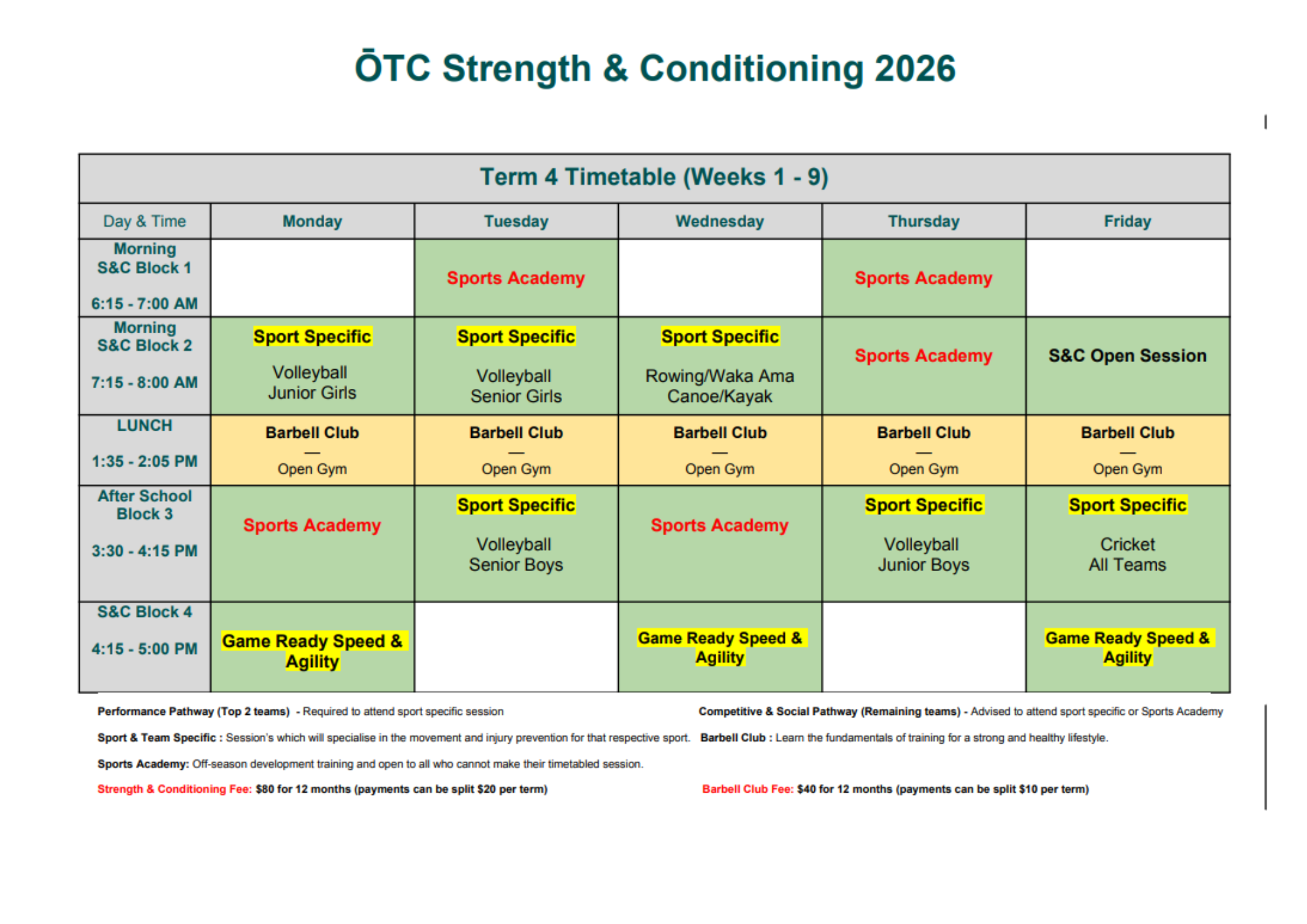
Strength & Conditioning — In-Season
For students currently competing in their school summer/winter sport season.
In-season Strength & Conditioning sessions are designed to help students maintain strength, speed and movement quality while managing the physical demands of training and competition.
Recommended attendance: One session per week.
[SIGN UP FOR IN-SEASON STRENGTH & CONDITIONING]
Sports Academy — Off-Season/Development Programme
For students currently outside their main school competition season.
Sports Academy provides the primary physical-development opportunity for students to build strength, speed, power and athletic movement skills year round or during their off-season.
Recommended attendance: Two sessions per week.
Barbell Club — Lunchtime Gym
Barbell Club provides students with a supervised opportunity to train during lunchtime.
Sessions support students to improve lifting technique, build confidence in the gym and develop consistent training habits within a positive and supportive environment.
Our Approach to Student Development
The programme follows the Ōtūmoetai College Youth Physical Development Model: a structured pathway that supports students throughout Years 9–13.
Training focuses on four key areas:
Movement Competency
Students learn the fundamental movement patterns required for safe and effective training, including squatting, hinging, lunging, pushing, pulling, bracing and carrying.
Athletic Movement Skills
Students are coached in acceleration, jumping, landing, deceleration and change-of-direction technique.
Strength, Speed and Power
Students progressively develop the ability to produce force before learning to express that force quickly through sprinting, jumping and power-based exercises.
Physical Robustness and Conditioning
Training develops the physical capacity required to tolerate sport, training and competition while supporting recovery and continued availability.
How Training Fits Around the School Sport Year
Ōtūmoetai College operates across summer and winter sport seasons.
In-season Sport-Specific training focuses on maintaining strength and speed, supporting physical robustness and managing fatigue around practices and competition.
Off-season Sports Academy training provides greater opportunity for physical development and progression.
This structure allows students to continue developing throughout the year rather than stopping physical preparation once their competition season finishes.
New to Strength & Conditioning?
Students who are new to the programme complete an On-Ramp process before joining regular training.
The On-Ramp introduces:
- Safe lifting technique
- Fundamental movement patterns
- Gym expectations and etiquette
- Appropriate equipment use
- How exercises and training loads are progressed
Students progress according to their movement competency and training readiness, rather than age alone.
Programme Expectations
Students attending Strength & Conditioning are expected to:
- Attend consistently and arrive ready to train
- Follow coaching instructions
- Use equipment safely and appropriately
- Respect the gym, equipment and other students
- Communicate injuries, pain or training concerns early
- Support a positive and focused training environment
Questions?
For more information about Strength & Conditioning at Ōtūmoetai College, please contact:
James Forster
Lead Strength & Conditioning Coach | jforster@otc.school.nz
Current Strength & Conditioning Timetable